Do I Have to Disclose When I Use AI?
Since August 2026, EU law requires some AI content to be labelled. Most blog posts and READMEs aren't covered. What the EU, the FTC and Google actually ask for.
 Steven Hylands

Since 2 August 2026, the EU has had a law that says some AI content must be labelled, and in June it published an official set of icons to do it with. My first thought was that's a very EU thing to do. I just can't imagine them being adopted well.
It does raise a fair question for a site like this one, though. Do you have to disclose AI use now? I'm not a lawyer, so treat this as a map rather than advice. But I've read the rules, and for most people the answer is still no. It's your call.
The short answer
- A blog post, portfolio, README or code you've reviewed yourself: no law makes you label it.
- Realistic AI images, audio or video of real people, places or events, published in the EU as part of your work, have to be labelled.
- Same for AI-written news or public-interest text that nobody reviewed or took responsibility for.
- Fake reviews and testimonials are banned in the US whether AI wrote them or not, so a label won't save you.
The EU's rule
The one that matters is Article 50 of the AI Act. It puts duties on the companies that build AI tools, who have to mark AI output in a machine-readable way, and on the people who use those tools to publish things. That second group is you.
If you use AI in a professional capacity, you have to disclose two things:
- Deepfakes, meaning AI-generated or manipulated images, audio or video that look like real people, objects, places or events and would falsely appear authentic. If it's clearly art, satire or fiction, a lighter-touch disclosure is fine, as long as it doesn't spoil the work.
- Text on matters of public interest that was generated or manipulated by AI and published to inform people. Unless a person reviewed it and someone takes editorial responsibility for it, in which case it's exempt.
Purely personal use is outside the Act, although a “personal” blog that sells your services probably isn't personal. Living outside the EU doesn't get you off either. I'm in Belfast, but the Act also covers people elsewhere whose AI output is used inside the EU.
The label has to be clear the first time someone sees the content, so for anything in scope, a badge at the foot of an article is too late. It goes at the top. Fines go up to €15 million or 3% of worldwide turnover.
Now read that list again. A blog post you wrote with AI help and edited yourself isn't a deepfake, and it's had human review with you taking responsibility for it. A README isn't covered. Neither is your portfolio or your newsletter. For most of what most people make, the law doesn't say a thing.
The EU's icons
On 10 June the Commission published a Code of Practice on transparency of AI-generated content, with three optional icons: a basic one, one for fully AI-generated content and one for partially AI-modified content. They're free to use.
Using the icons is optional. If you're in scope, disclosing isn't, and I'd still use the EU icon for it, at the top. It's the official one, even if I can't see it catching on.
The US and the FTC
There's no general US law that says you have to label AI content. What the FTC cares about is deception.
The clearest rule is its ban on fake reviews and testimonials, in force since October 2024. It covers reviews by people who don't exist, and the FTC calls out AI-generated reviews by name. That's a ban rather than a labelling rule. You can't make a fake customer review honest by sticking a badge on it.
Beyond that, the usual rules apply. If AI makes it look like a real person said something, or a real customer used something, and that misleads people, you've got a problem whether it's labelled or not.
And Google
Google doesn't penalise you for using AI. Its guidance on AI-generated content says it rewards helpful content however it was made, and treats AI content churned out to game rankings as spam, like any other spam.
Its helpful content guidance asks you to think about Who, How and Why. The “How” is about process. If automation substantially generated something, Google says that should be obvious to readers, through a disclosure or some other way. It's a recommendation, but it points the same way.
So why bother with a badge?
For me, it's not about forcing anyone to disclose. It's about getting to a point where we're comfortable disclosing, because we can see it builds trust in what we make.
Everybody knows stuff is being generated by AI. That's a fact now, and there's only going to be more of it. I'm trying to work out what the world looks like in this new reality, and to give people a few tools that at least help us use AI thoughtfully.
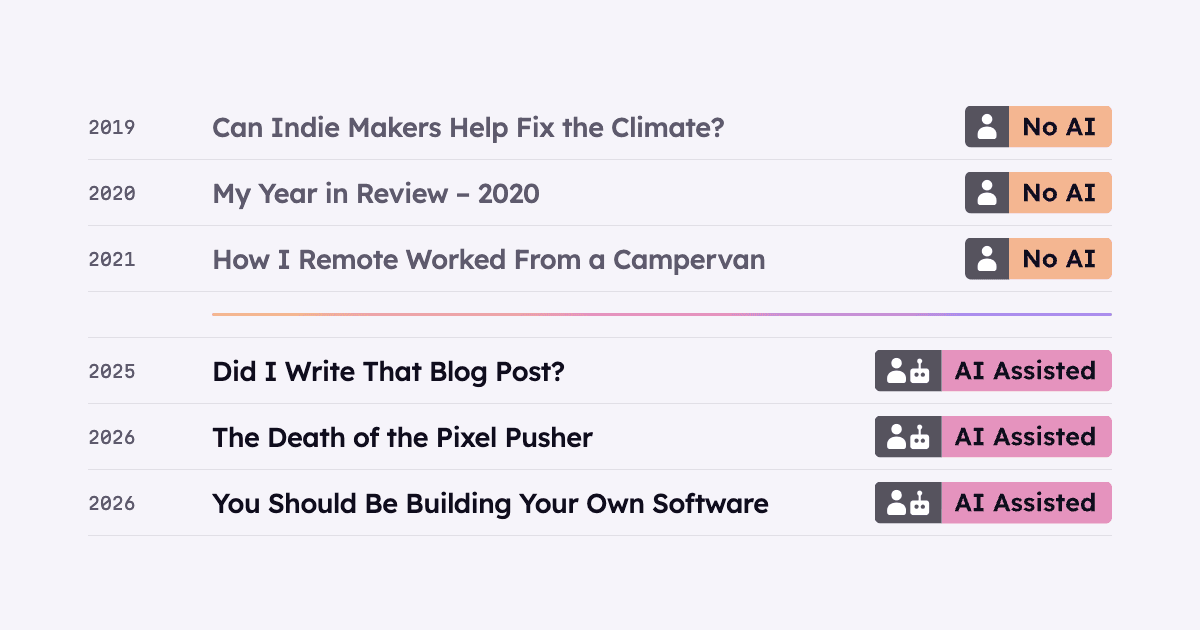
The interesting question, to me, is how we decide where AI Generated ends and AI Assisted begins. Some of what we make will be generated by AI. That's inevitable. We've been using tools to generate stuff for us for decades, and we never put badges on any of it. The difference is the thinking behind the thing. How much was truly driven by a person, and how much did the AI decide? That's the key question.
The EU icons don't really ask it. They flag AI content and that's it. There's no EU icon for No AI, and none for the middle, where a person led the work and AI helped. That middle is where most of us are, and it's what AI Assisted is for.
To be clear, the badges are self-declared. There's no verification behind them and they won't make you compliant with the AI Act. If something you publish is in scope, put the EU icon at the top. If it isn't, which is most of the time, a badge still lets you say how it was made.
Adding one
Pick the badge that's honest, copy the snippet from its page and paste it where you want it. If you're not sure which fits, the No AI, AI Assisted and AI Generated pages explain where the lines sit. And if an AI tool helped you make the thing, it can pick and add the badge for you.
This is how things stood in October 2026. The rules are new and the guidance is still settling, so check the sources before you rely on any of it.
I'd love you to use mine over the EU's, but I'll try not to be too forward about it. Agree with me, ultimately. Maybe go and read my own blog. Why not?